Pretoro
A bit of history
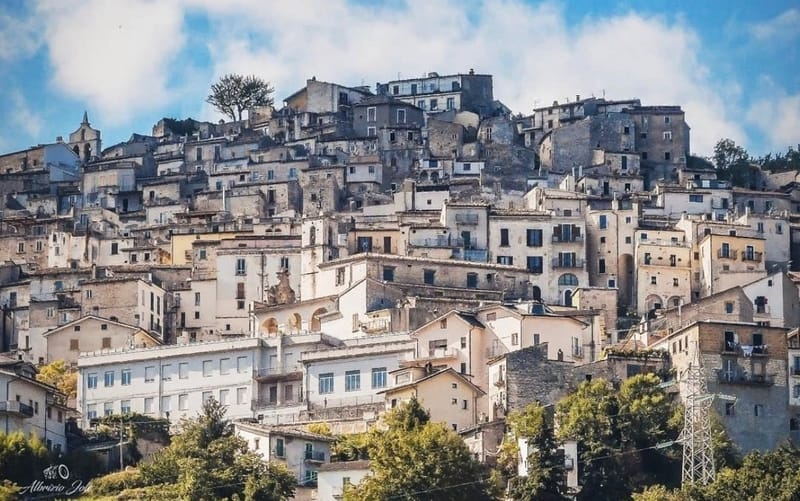
The name derives from the Latin Praetorium ("place of gathering of soldiers") and indicates a point of observation and surveillance of the passages in the Peligna valley, inhabited by the Italic populations of the Peligni of Sabellic lineage and the Frentani of Samnite lineage, both of Oscan language. The first certain information on the origin of the village comes from the appearance in the documents of the name Praetorium, signifying a "gathering of soldiers", probably to guard the pastures of the Maiella. In the 15th-16th centuries, the feudal lords were the Orsinis, followed by the D'Alvianos at the beginning of the 16th century and then by the Colonnas, the Cantelmos and the Acclozamoras. The Cantelmos built a castle on the remains of the destroyed medieval castrum Pretorii de Theti and it was around the new castle, now in ruins, that the current village was formed and developed, transferring the original settlement from the valley upstream. At the turn of the 19th-20th centuries, wood lathe working and other craft activities such as stone working developed. Immersed in a naturalistic context of great charm and countless attractions, Pretoro shows itself to visitors with its cluster of houses perched on the rocks, presenting itself as a small nativity scene set among the mountains. Walking through the narrow streets of the village you come across magnificent religious buildings among which, the most important in the country, is the church of Sant'Andrea Apostolo with the particular floor that adapts to the shape of the rock. No less important are the church of San Nicola, also known as the church of San Domenico and the church of the Madonna della Mazza or Santa Maria della Mazza from the 13th century which bears witness to the passage of the French, was built by Cistercian monks with the facade facing northwest, towards France. What distinguishes this small Abruzzo village is the craftsmanship of wood and stone. Woodworking is an art that has been practiced for many generations. In particular, the village of Pretoro is famous for the creation of spindles, traditional Abruzzo guitars for pasta, kitchen utensils, as well as chairs and furnishings.
Learn More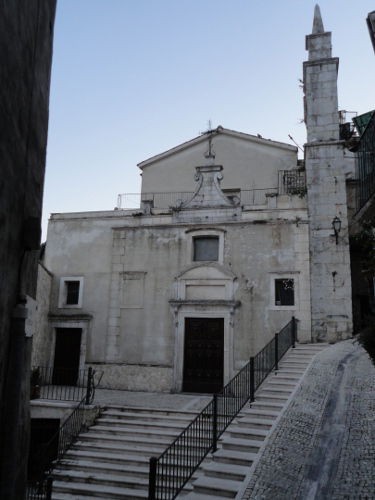
St Andrew's Church
The church of Sant'Andrea is located inside the historic centre, upstream of the village and represents the main church of the village. The facade, preceded by a wide staircase, has a square stone wall facing with ashlar corner pieces and portal and window frames. In axis there is the main portal with corbels, semicircular tympanum, window and gable above the horizontal crowning frame of the seventeenth-century type. The church has an irregular layout with two naves and a chapel on the right side. The central nave is covered with a barrel vault with lunettes, ribbed vaults on the side bays and on the right side chapel. The external covering is made with staggered pitches on an irregular plan with a roof of tiles. The internal decoration, of the seventeenth-eighteenth century type, is extremely simple and has an order of Doric pilasters leaning against the pillars and squares in the vaults. The altar, on the other hand, is made of commisso marble and is inserted in the right side niche and polychrome glass windows.
St. Nicholas Church
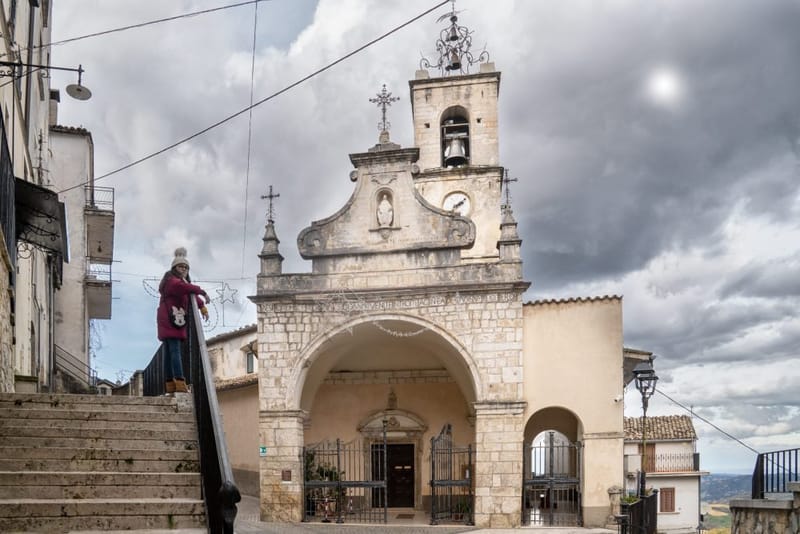
The Church of San Nicola is located in the historic center of Pretoro, in the Majella National Park. Its current configuration dates back to the years between the 16th and 17th centuries, although traces of the previous Romanesque layout remain in the external masonry and in the single-lancet windows overlooking the valley. Dedicated to the eastern saint, the church actually venerates San Domenico Abate, patron saint of Pretoro and object of a very ancient popular cult that goes beyond the borders of the town. In fact, it is from here that the complex celebrations in honor of the Saint begin on the first Sunday of May, with the fervent participation of the faithful, which then conclude in the upper part of the village with the representation of "Lu Lope", a re-enactment in the form drama of a miracle performed by the Saint. The building has a facade in Majella stone in which a large arch leads to a portico which in turn leads to the portal of the church. The interior has three naves with an irregular plan: the central nave and the lateral one on the right have a rectangular shape and the lateral one on the left, which leads to the place of worship, has a trapezoidal shape. In it, in addition to several statues of saints particularly venerated in the area, you can admire two works of particular artistic value: a Pietà in polychrome terracotta from the 17th century and a large portal carved in wood dating back to 1630, recently restored and placed on a wall near the entrance.
Maielletta ski resorts
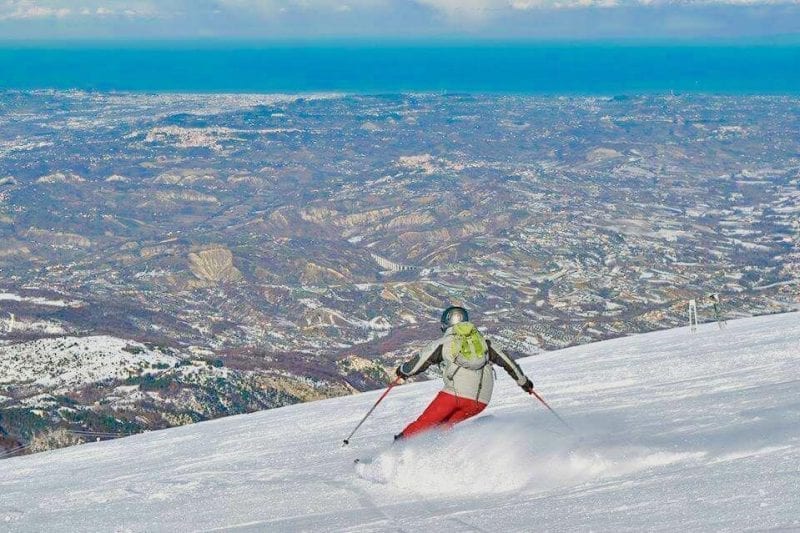
When we talk about Abruzzo and its mountains, the Gran Sasso immediately comes to mind, however the other mountain that dominates this land, the Maiella, also known as "The Sleeping Beauty" is also worthy of the same attention. In fact, thanks to its wonderful landscapes it is also a very popular destination for ski enthusiasts. The two localities Passo Lanciano and Mammarosa develop in one of the few points suitable for skiing on the impervious Maiella massif (2798 metres). The wide scenarios range from the slopes to the Adriatic Sea, and the landscape, from the top, is truly breath-taking so much so that, if the day is very clear, it is possible to see the Adriatic Sea (with the centers of Pescara and further inland Chieti), the peaks of Velino-Sirente and Gran Sasso itself. Passolanciano and Mammarosa are 1.5 km apart, however, to move from one to the other, you need a ski bus or a snow taxi, since they are not joined by skis. Going up from Pretoro, further downstream (starting from 1350 metres) is the Passo Lanciano station equipped with a three-seater chairlift, two ski lifts and two conveyor belts. The slopes for alpine skiing are: a red slope "the third", a black one "piston", a blue one "la Panoramica" which descend into the beech forest for a total length of 6.150 km. There is also a snow park area, a school camp, a kindergarten for the little ones and a 5 km Piane di Tarica cross-country ring. After passing the ski resorts of Passolanciano, continuing on the same road, after 10 minutes by car, you arrive at the highest ski resort (2000m) of Mammarosa. Here the ski slopes are more numerous: there are slopes for children and novice beginners and several slopes for more experienced skiers. Below you can consult the personal website of the two ski resorts and watch a descent on skis. Below you can consult the personal website of the two ski resorts and watch a descent on skis.
Learn More