Ortona
The Stalingrad of Italy
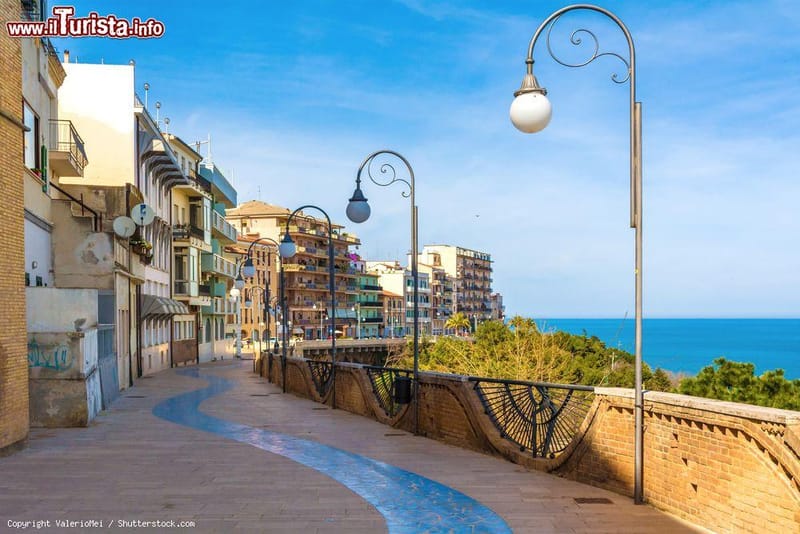
A bit of history
Ortona, also known as Ortona a Mare until the 1930s, is an Italian town of 23,277 inhabitants in the province of Chieti in Abruzzo and overlooks the Adriatic Sea. The port of Ortona is one of the most important in the entire Adriatic and is the main one in Abruzzo in terms of basin, seabed and movement. The very ancient history of the city dates back to the Frentani people, who used the commercial port as the main economic source of the area. Roman city from the beginning of the 3rd century BC, it was occupied, after the fall of the Western Roman Empire, first by the Goths, then by the Byzantines, by the Lombards and finally by the Normans who set it on fire (11th century). Resurrected in the Swabian era, it returned to flourish economically. In 1258 the city permanently housed the relics of St. Thomas the Apostle in the Cathedral, becoming a point of reference in the religious field. After various battles with the rival city of Lanciano, Ortona passed into the hands of Jacopo Caldora who rebuilt the walls. City dear to Margaret of Austria, who had Palazzo Farnese built there (second half of the 16th century). During the nineteenth century it was culturally represented by the composer Francesco Paolo Tosti and the poet Gabriele D'Annunzio. During the Second World War, Ortona became the maritime head of the Gustav Line with the opposite end to Cassino and was the scene of a hard battle between the Germans and the Allies which involved uninterrupted bombardments for 6 months and which also involved the center of the city, so much so that Winston Churchill he called it "The Stalingrad of Italy", as, similarly to the Russian city, Ortona experienced a long battle in the heart of the city with the destruction of a large part of its artistic treasure. Today the city is highly developed and rebuilt, the main seaport of the Abruzzo region with its port, as well as several times decorated with the Blue Flag.
Learn More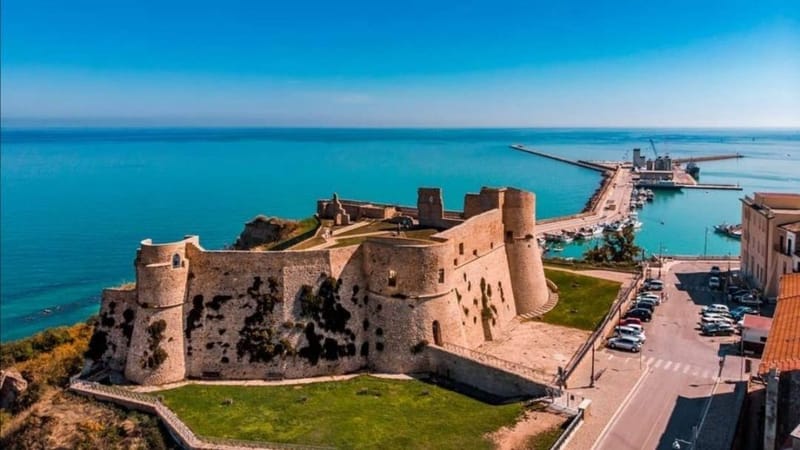
Aragonese castle
The Aragonese castle is one of the symbols of the city of Ortona. The current building dates back to the years between 1450 and 1470, but in this panoramic position there was already a medieval fort previously present. The previous structure was wanted by the leader Giacomo Caldora, who fortified the city with the imposing walls that today bear his name. The fort and the walls served to protect Ortona from the invasion of the Aragonese, who however managed to enter the city in 1452. At that point they decided to modify the castle giving it a quadrangular shape in the Renaissance style. Its position is directly overhanging the sea, so as to protect the city port. From here it is also possible to admire the Trabocchi coast which starts right from Ortona and stretches southwards up to Vasto. Ortona had always needed to be protected, because it has been an important commercial port since ancient times. Originally the castle had five towers arranged along the walls surrounded by a moat. Inside the castle there was a tower that was used for any retreats. Today only four towers are left standing, i.e. the corner bastions, round in shape and highly sloping, as was usual in the Aragonese scheme. The scarping technique is also found in the base of the walls and was used to ensure greater protection for the fort. The towers of the Aragonese castle have the same height as the walls and this was designed to make the patrol walk easier. In the second half of the 16th century, the castle was revised by Spanish architects who, in the meantime, controlled the territory. In that context the central tower was eliminated and a smaller quadrangular was added along the western walls. In the following centuries it changed hands several times between private individuals and the municipality and performed various functions, such as a gunpowder deposit, a private home and an English garden. Today it is again in the ownership of the municipality of Ortona which, after a consolidation and a profound restructuring due to the damage sustained during the Second World War, has returned it to the citizens. Of the four corner towers, only three have survived. Furthermore, only a perimeter wall with decorations on the frame remains of the residential building leaning against the western side.
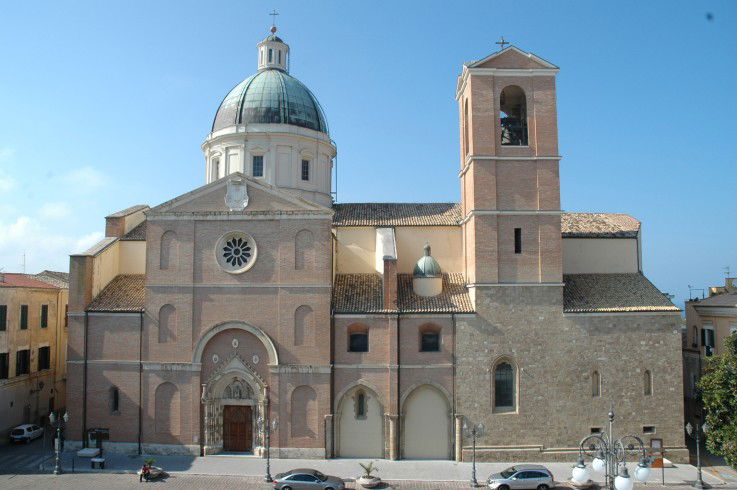
St. Thomas Cathedral
The cathedral of San Tommaso is the most important church in Ortona. Over the centuries it was rebuilt several times, such as in 1125 due to an earthquake and, in 1127, due to the destructive fury of Goffredo the Norman. Even in the sixteenth century it was rebuilt, after the Turkish invasion in 1566. Other reconstructions were carried out in the seventeenth and eighteenth centuries, while the last, necessary one, was carried out between 1946 and 1949 when the city fell victim to the bombings of the second war world in 1943. The cathedral is dedicated to St. Thomas, whose relics it has kept since 1258, when his remains were transferred here from the island of Scio. From an architectural point of view, the large facade is made of terracotta and its monumental portal is the original one from 1311, reassembled after damage from the bombings. Even the side entrance is the historic one, recovered after the war. The interior of the church is organized around a large nave overlooked by the side chapels. The presbytery is raised and covered by a dome that is clearly visible even from the square in front of the church. Under the cathedral of San Tommaso there is a crypt, in which the remains of the saint are kept. This space is covered with a system of radial beams dating back to 1969. In the lower part of the stone there are two holes which in the first centuries of Christianity were used to introduce balms and perfumes such as aloe, myrrh and incense into the tombs. Furthermore, contact relics were made through these holes, i.e. objects that were kept in contact with the remains of the saint. To complete the cathedral of San Tommaso there is the diocesan museum, which preserves various works, such as sacred vestments, ceramics, silverware and ancient medieval finds. This is housed in three rooms that mark the left side of the church, where in ancient times there were the chapels of the Rosary, the Baptistery and Sant'Onofrio.
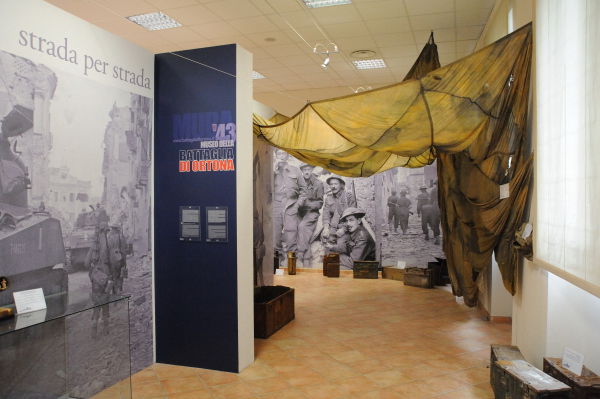
Battle Museum
The museum of the battle of Ortona was set up inside the former convent of Sant'Anna, after the same spaces were used as the Casa del Fascio in the twenty years. The battle of Ortona took place between 20 and 28 December 1943, during the Second World War, on the Gustav Line. The clash was between the Canadian allies and the German Nazis. In that clash, Hitler commanded that the fortress of Ortona should be defended to the last man. The clashes had been quite violent and were strategic for the allies in order to open a passage towards Rome on the Adriatic side. About one million and two hundred thousand bullets rained down on the city, which turned it into a pile of rubble and the Germans, with the intention of eliminating landmarks, blew up the bell tower of the city. The arrival of Canadian reinforcements by sea forced the Germans to retreat. The toll had been dramatic: 800 German dead, 1,400 Canadian dead and 1,300 civilian dead who didn't want to leave their homes during the clashes. The museum of the battle of Ortona opened its doors in 2002 and displays a detailed itinerary on the events that saw Ortona as a protagonist during the Second World War. Inside, the materials used by the soldiers and generals who took part in the battle and who, returning from the war, donated their equipment to the city are exhibited. These pieces are flanked by armor, weapons and war material found in the area. The exhibition itinerary is divided into three sections: the first is dedicated to the population involved in the war. Here photos, drawings and diagrams tell the climate of the period and are placed side by side with the first war memorabilia, such as telescopes, helmets and German and American tins. The second pertains to the two sides that confronted each other in Ortona: the Nazis and the allies. Through the signs on the wall the story is explained in detail. Added to this are the reconstructions of life in the trenches for the soldiers and in the caves for the displaced persons. Finally, the third shows military strategies through drawings and maps used in battle planning.
Canadian Military Cemetery
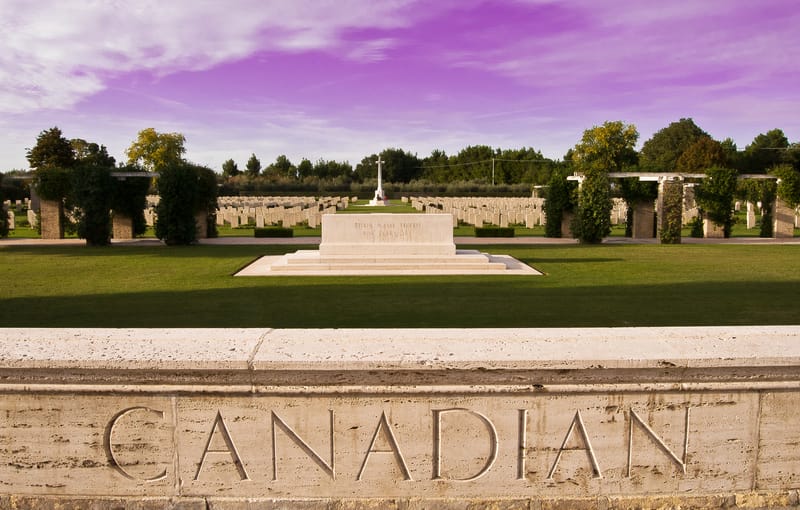
The Commonwealth cemetery of Ortona stands near the river 'Moro' and takes its name from it. On 3 September 1943 the Allies invaded the Italian continent, the invasion coincided with an armistice made with the Italians who then returned to the war alongside the Allies. The Allied objective was to draw German troops from the Russian front and more particularly from France, where an offensive was planned for the following year. Progress through southern Italy was rapid despite stiff resistance, but by the end of October, the Allies were facing the German winter defensive position known as the Gustav Line, which stretched from the Garigliano River in the west to the Sangro in the east. The Allied force which had fought its way up the Adriatic occupied the Sangro River positions by 30 November. The 1st Canadian Division crossed the Moro River on December 6 and despite strenuous resistance, captured Ortona on the 28th, after a week of fierce fighting on the ground. The 2nd New Zealand Division advanced inland, but thereafter there was virtually no movement east of the Apennines until after the fall of Rome. The cemetery site was selected by the Canadian Corps in January 1944 and contains 1615 graves of those who died during that fight at the Moro River. The burials, other than those of members of the Canadian Forces, are mostly located in lots 12, 13 and 16.
Learn More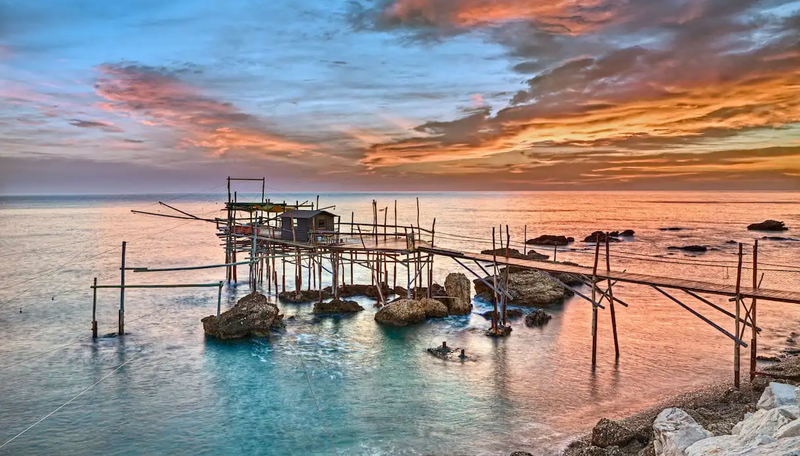
Trabocchi coast
Chiunque sia mai stato in Abruzzo e abbia visto il suo bellissimo litorale, non potrà dimenticare lo splendido panorama dei trabocchi, insoliti giganti che emergono dalle acque. Siamo lungo la Costa dei Trabocchi, quel tratto di litorale del Medio Adriatico compreso tra Ortona e Vasto che ha ispirato anche Gabriele D’Annunzio. I trabocchi sono strutture davvero particolari: esse infatti si reggono su palafitte che si stagliano sull’azzurro del mar Adriatico e offrono un panorama incredibile. Molti trabocchi sono stati restaurati e riportati alla loro bellezza originaria – alcuni di essi ospitano ristoranti dove potrete gustare qualche saporita pietanza locale, nel pieno rispetto delle tradizioni abruzzesi. Impossibile descriverli tutti: ciascuno di loro ha una storia lunga millenni da raccontare, e solo ammirandone la maestosità è possibile capire appieno quale meraviglia possa suscitare nei visitatori. Ma la Costa dei Trabocchi ha ancora molte altre bellezze da regalare ai turisti. Le sue spiagge, ad esempio, sono tra le più affascinanti dell’intero litorale dell’Adriatico, e hanno il vantaggio di non essere ancora molto conosciute al turismo di massa. Luoghi splendidi come la spiaggia di Ripari di Giobbe, oggi considerata area protetta, o come le piccole calette del Golfo di Venere meritano assolutamente di essere scoperte. Acque azzurre, sabbia fine e panorami mozzafiato sono garantiti. Se siete alla ricerca di una vacanza a contatto con la natura, poi, avrete solamente l’imbarazzo della scelta. litorale. E che dire della Riserva Naturale di Punta Aderci? Splendide distese verdi che alternano vigneti a campi di grano, magnifici colori e odori che lasceranno un segno indelebile tra i vostri ricordi. Premendo il link indicato di seguito è possibile effettuare una pedalata lungo la costa dei trabocchi
Learn More