Guardiagrele
The city of stone
Guardiagrele
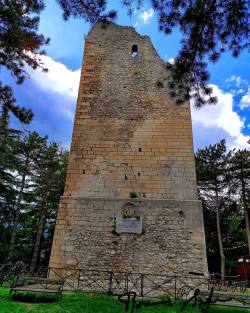
Tradition has it that the village was formed by the presence of a Lombard tower, currently called Torrione Orsini, which was and still is located in the highest and flattest part of the hill to defend the population of the village below from the frequent barbarian invasions. With the disintegration of the Roman Empire, the raids having increased, the population moved under the tower, building houses. Defined by the poet Gabriele D'Annunzio as the terrace of Abruzzo for its enchanting panorama, Guardiagrele is considered one of the most beautiful villages in Italy. In fact, thanks to its numerous terraces, it is possible to see not only the sinuous lines of the Majella National Park, but also the angular ridges of the Gran Sasso mountain massif which is in the distance and, if the weather permits, it is even possible to see the Adriatic coast which makes the vision of this marvelous landscape even more suggestive. Externally Guardiagrele is surrounded by gates and towers from the Middle Ages, which mark the entrance to the town, but the most suggestive part is certainly represented by the historic centre. The narrow streets that rise from the outer ring road towards the center wind through paved slopes, narrow alleys and streets that lead to Piazza Duomo where the Santa Maria Maggiore cathedral is located. By pressing the link below it is possible to take a walk around the village.
Learn More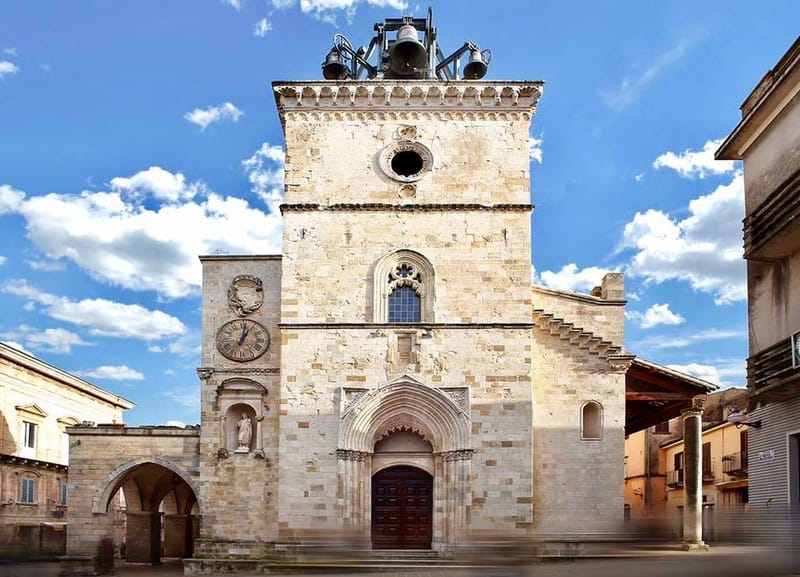
Cathedral of Santa Maggiore
Beyond a local tradition that would like to trace the foundation of the church back to 430 AD. C., built on the remains of a pagan temple, the architectural vicissitudes of Santa Maria Maggiore find their most documented origins between the tenth and twelfth centuries, and continue during the thirteenth and fourteenth centuries. Strong testimony of its most ancient history is given by the peculiarity of the facade, which immediately catches the visitor's eyes when he sees it suddenly appearing among the houses in the centre. In fact, it has a truly unusual shape, with a central tower structure that also serves as a bell tower, probably imported from the French tradition of the Cluniac monks, where this solution was quite widespread. The façade offers a beautiful fourteenth-century portal with a pointed arch and, in the lunette, a fifteenth-century sculpture depicting the Coronation of the Virgin; above a window of the so-called monofora type (i.e. with a single opening) decorated with a refined play of stone fretwork. The two small heads, one male and one female, that can be seen today were added in the fifteenth century. On the sides of the church there are two porticoes. The one on the left, partially rebuilt and freed from the houses that had been added to it over the centuries, leads to the entrance to the former chapel of the Madonna del Popolo, with its beautiful late Renaissance portal. Along the portico is a newsstand entirely decorated with stuccos which surrounds, as if it were a frame, the fresco of the Madonna del Latte by an unknown fifteenth-century artist. Under the portico which runs along the opposite side, with tall columns covered by a roof made of wooden beams, there is another Renaissance portal dated 1578. A little further on, set in the wall, are the coat of arms of the city and the emblems of the major noble families of Guardiagrele which were walled up here in 1884 so as not to disperse them. Entering Santa Maria you will notice how the inside has a completely different appearance from the outside, the result of the radical Baroque transformations that followed the disastrous earthquake of the early eighteenth century. One of the main effects of these transformations, from the point of view of the architectural structure, can be seen in the presence of a single raised space, which is accessed with a central staircase. Four stucco altars alternate along the two walls on each side. In the last altar on the right you can admire a singular and unusual work of sculpture resulting from an eclectic assemblage of pieces of various origins: a kind of tabernacle in carved and painted stone. In the lower part it has a decoration with vegetable elements from the 13th century and in the upper part two angels from the 15th century holding up a coat of arms. In the center an iron door protects the interior decorated with a composition of bas-relief panels: a central female figure that can be thought of as the Assumption and two panels with a pastoral scene and, perhaps, the biblical scene of Adam and Eve.
Church of San Francesco
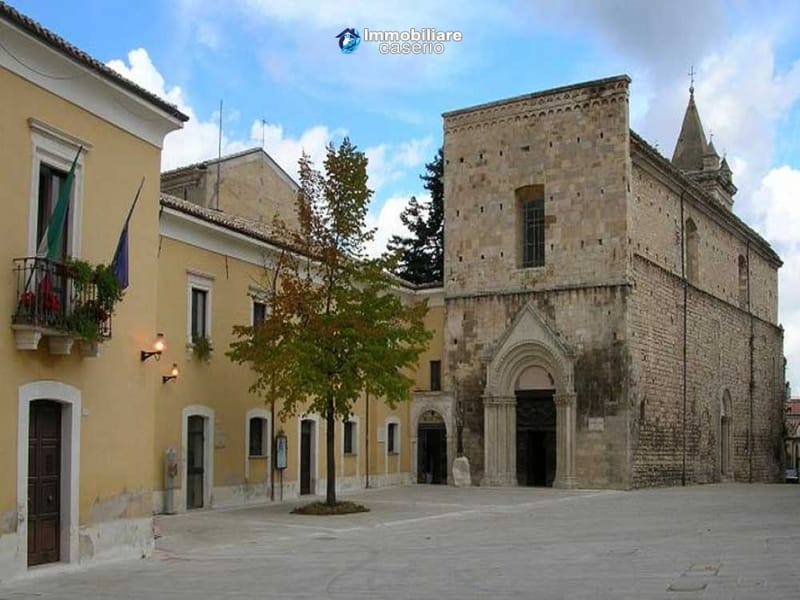
The Church of S. Francesco represents, after Santa Maria Maggiore, the most important architectural and urban development of Guardiagrele. The magnificence of the fourteenth-century church bears witness to and illustrates the new role that this part of the town assumed: the square in front of the church, used as a market, became the economic hub of the urban settlement. The main façade of the Church is rectangular in type, covered with stone ashlars with a frame of small arches and a median frame in pure fourteenth-century style. On the right side of the monument, on the structure built with the use of stones, the outlines of the pre-existing windows now walled up, and the eighteenth-century masonry above in irregular stone, built to allow the construction of the barrel vault inside. Still on the right side there are two portals, a smaller one, now walled up and the other which constitutes the second entrance to the Franciscan church. Moving inside, the architectural layout of the church of San Francesco has a single nave, without side chapels with a presbytery choir and a sacristy behind it, above which the bell tower rises. In the compartment below the bell tower it is still possible to see an original ogival cross vault with cylindrical stone ribs and polychrome decorations.
Museum of tradition and customs
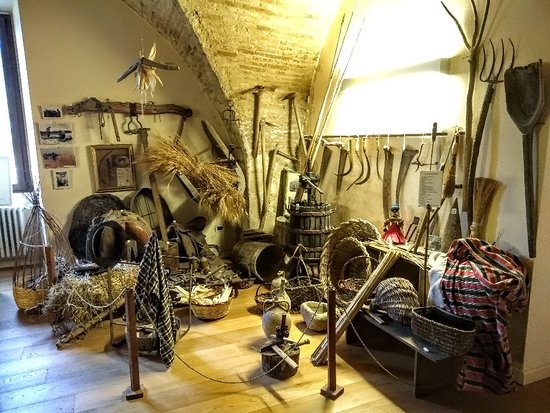
The Costume and Tradition Museum of Guardiagrele was born in the eighties and today, with its approximately seven hundred exhibits, it tells and bears witness to a particular historical period, the one between the nineteenth and twentieth centuries, in which the Guardiagrele reality was predominantly peasant and artisan. A visit to the Museum allows you to grasp two important aspects of the life of the Guardia di Campiglio of the past: that of the patriarchal family, with its rules, its rhythms, its affections and that of the peasant and artisan community which is expressed through images of great industriousness in which many trades find space, some of which have disappeared. Some of the most characteristic environments of the domestic life and of the artisan industriousness of the Guardiagrele between the 19th and 20th centuries have been rearranged in the rooms. The kitchen features authentic elements, a kitchen with oven and fireplace, sideboards, pantries and crockery furniture with plates, glasses and copper pots, as well as the necessary for bread-making and an all-female space dedicated to spinning and weaving activities, with still working loom, spinning wheel, warper and other tools. The bedroom, reconstructed to witness ancient customs linked to marriage, such as the display and the "appreciation" (esteem) of the dowry, which relatives were invited to admire; a section is dedicated to women's clothing and handcrafted jewels, worn on the most important occasions. The Hall of Arts and Crafts Other spaces are instead reserved for the artisan activity, always flourishing in Guardiagrele, and exhibit tools that are now disused or even unknown to the new generations, such as those of cabinetmakers and carpenters, dyers and shoemakers, potters, chair-makers, coppersmiths and the masters of wrought iron. The Costume Museum, the pride of the city of Guardiagrele, welcomes thousands of visitors every year and takes them on a real journey through time.
Gastronomy
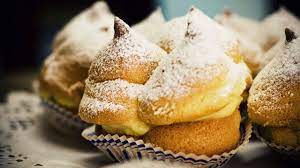
The culinary symbol of the town is the renowned sweet with three peaks: le sise delle monache. There are various hypotheses on the origins of this name: the most probable would be linked to the nuns who lived in the Convent of the Poor Clares around 1300 and who would have invented the dessert in memory of the martyrdom of the cutting of Sant'Agata's breasts. The more mischievous thesis instead refers to the nuns' habit of inserting a bundle of cloth between the two breasts in order to make the surface of the chest, compressed by a band, flat and without protuberances. On the other hand, there are those who associate the shape of the product, also known as Tre Monti, with the three most important massifs in Abruzzo, the Apennines, namely the Gran Sasso d'Italia, the Maiella and Monte Sirente-Velino. The original recipe is still secret and well-kept in the cookbooks of Guardia, which are handed down from generation to generation. However what can be said is that the sponge cake base is made with flour, eggs and sugar and cooked in the oven for about 35 minutes. While the custard is the classic one, made with flour, eggs, sugar, milk and cinnamon. The dessert is entirely handmade, also for the creation of the characteristic three-pointed shape, which is given when mixing. After the cooking phase, the desserts are filled with the cream, left to cool and dusted with plenty of icing sugar.